
Is It Worth Getting An Attorney For A Car Accident | 10 Key Reasons
You were involved in a collision; your vehicle was damaged and you’re wondering whether it’s possible to represent yourself regarding the claim for damages resulting from the auto accident, or should you seek legal assistance?
The answer to this question will typically depend upon three factors: your injuries: how clear fault is; and when (and if) the insurance company requests a statement or settlement.
This is a “fault” state. Blame matters when determining compensation amounts. For example, the insurer determines that you were partially responsible for the accident, then your compensatory damages will be reduced accordingly.
Raymond W. Ganim esq., has represented over 1000 injured clients in Fairfield County since opening his Stratford office, serving both Bridgeport & other surrounding communities, including Stratford & Shelton.
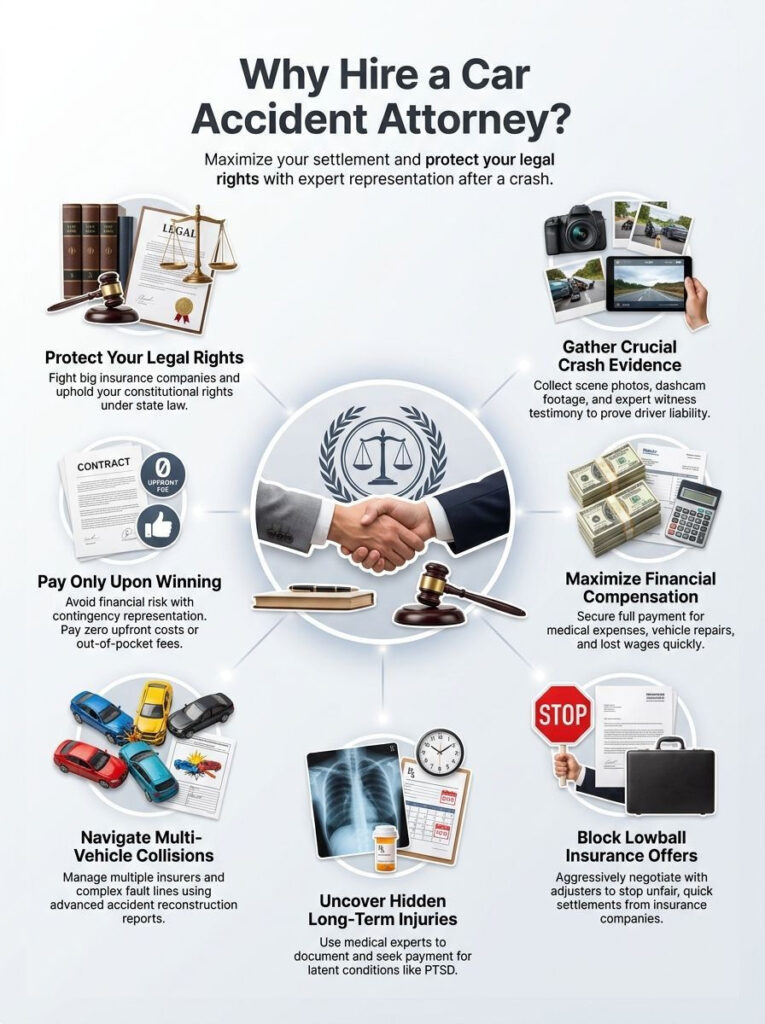
Below are some key take-aways to help guide you:
• Raymond W. Ganim esq., has been providing representation in Connecticut, for more than twenty-five years, from his Stratford office, as well as representing injured individuals throughout Fairfield County, specifically in Bridgeport.
• in Connecticut, most negligence-based claims must be filed within two years. Many of these claims also have a three-year outside limit. Therefore, waiting may damage or end a claim.
• the comparative negligence statute provides that recovery shall be reduced by the share of responsibility for each party at-fault. Generally, no one can recover if they are more than fifty percent at-fault for an accident.
• the contingency fee structure in Connecticut provides for sliding scale fees based upon total recovery limits. The initial fee cap is thirty-three and one-third percent of the first $300,000.
Why Legal Representation Matters After a Bridgeport Car Accident
Car crash claims are frequently deceptively straightforward in the beginning and quickly get muddled over time. The CTDOT (in an updated release issued in 2026) stated that preliminary road fatality numbers from 2025 decreased by 12% from prior years; however, the number of fatal pedestrian accidents continued to exceed the five year average while bicyclist fatalities have dramatically increased. That is why it is clear that serious injury cases continue to be a regular occurrence of everyday traffic activities within our area.
This is especially relevant when we talk about Bridgeport. Many times these types of incidents go beyond just repairing the vehicle involved. Follow-up treatment may be required, lost wages due to missing work could occur, liability disputes may arise among parties involved as well as insurance adjusters trying to settle the claim before they have a complete understanding of what occurred.
Connecticut is a tort jurisdiction. Therefore, if there is a dispute regarding liability, the strength of evidence provided will determine how much recovery, if any, you will receive from the other party.
Therefore, when asked “do I need an attorney after a car accident?” the most practical answer is this: Yes for sure — unless you had a minor no-injury collision where there was clearly liability and the opposing party has already made you a reasonable and fair settlement offer. For accidents resulting in injuries; collisions involving commercial vehicles; collisions that resulted in whiplash but were caused by a rear end collision; or, there is pressure being applied by an insurance company adjuster to resolve your case quickly, then consulting with a lawyer typically produces different results.
Attorney Raymond W. Ganim provides complimentary consultation sessions, represents clients throughout Bridgeport and the surrounding areas and has spent decades providing personal injury representation services in Connecticut.
Advantages of Engaging a Car Accident Lawyer in Fairfield County
If you are wondering what does a car accident attorney do, the short answer is simple: protect the timeline, gather proof, value every loss, and deal with the insurer so you can focus on getting better.
| What a lawyer handles | Why it helps you |
|---|---|
| Crash investigation | Finds photos, video, witness statements, report details, and expert proof before they disappear. |
| Liability analysis | Pushes back when the insurer tries to shift blame and cut your payout. |
| Damage calculation | Counts medical bills, wage loss, future care, pain, and vehicle-related losses in one demand. |
| Insurance negotiations | Keeps you from making statements or accepting offers that undervalue the case. |
Upholding Your Rights Under Connecticut Law
Connecticut Personal Injury Law provides you with rights; however, it also creates an opportunity for insurance companies to dispute them. As Connecticut follows the principles of Modified Comparative Negligence (Modified) in determining your entitlement to compensation, your amount of recovery will be determined by your degree of responsibility for the accident. If the court determines that you were more than 50 percent responsible for the accident, then you would not be entitled to recover any money from the insurance company.
Additionally, the Connecticut Insurance Department requires all automobile liability policies to contain minimum levels of uninsured motorists (UM), under-insured motorists (UIM) and personal injury protection (PIP). Specifically, UM/UIM coverage is to be no less than $25,000 per person and $50,000 per occurrence. This becomes important when either the at-fault party leaves the scene without providing their identity (hit and run) or the at-fault party has limited coverage.
• If fault is disputed, a lawyer can build evidence to keep your percentage of blame as low as the facts allow.
• If the other driver is uninsured or underinsured, counsel can review whether your own policy opens another path to recovery.
• If the deadline is close, counsel can file before the clock runs out instead of waiting for the insurer to “keep reviewing.”
Conducting Thorough Investigations to Establish Liability
Prompt investigation of a potential claim is crucial in establishing a strong claim. According to the Connecticut State Police, many basic police reports regarding traffic accidents will be accessible through an on-line system within approximately thirty working days. Reviewing these reports quickly allows a lawyer to compare what information was obtained by the investigating officer with your photographs of the vehicles involved, identify any witnesses and provide some comparison of repair estimates based upon the damage pattern created by the accident. However, a thorough investigation includes much more than just obtaining a copy of the police report.
• If fault is disputed, a lawyer can build evidence to keep your percentage of blame as low as the facts allow.
• If the other driver is uninsured or underinsured, counsel can review whether your own policy opens another path to recovery.
• If the deadline is close, counsel can file before the clock runs out instead of waiting for the insurer to “keep reviewing.”
Ensuring Maximized Compensation for Medical Expenses and Vehicle Repairs
Insurance companies generally begin evaluating claims by tallying medical expenses, lost wages and other documented expenses. However, a skilled attorney evaluates claims from multiple perspectives including those yet to arise such as:
- Projected future medical treatment.
- Loss of income due to missed time at work or decreased earning capacity.
- Permanent injuries resulting from the accident.
- Out-of-pocket expenses incurred subsequent to the accident which may include things like prescription medication, home health care services etc.
Research conducted by the Insurance Research Council in 2014 found that auto injury claimants represented by attorneys had significantly higher average gross payments compared to unrepresented claimants. Although this study does not guarantee that greater attorney fees always result in increased net recovery in every case, it illustrates why serious auto-related injury claims typically warrant legal representation.
| Damage category | What should be included |
|---|---|
| Medical expenses | ER care, imaging, specialist visits, physical therapy, prescriptions, and future treatment |
| Income loss | Missed paychecks, used sick time, lost overtime, and reduced future earning capacity |
| Noneconomic damages | Pain, daily limitations, sleep disruption, anxiety, and loss of normal activities |
| Vehicle losses | Repair or total loss value, towing, storage, rental costs, and damaged personal items |
Managing Complex Negotiations with Insurance Companies
Negotiation is where many people lose value without realizing it. A quick recorded statement, a broad medical authorization, or a settlement signed before symptoms settle can weaken a claim fast.
An Insurance Research Council poll released in 2016 found nearly two-thirds of auto injury claimants who contacted a lawyer did so within one week of the crash. That tells you how early the pressure starts.
If you are asking should i talk to insurance adjuster without lawyer, the safest answer is usually to keep the conversation brief until you know the full value of your case.
- A lawyer screens calls and keeps the adjuster focused on facts, not traps.
- A lawyer prepares the demand package with records, bills, wage proof, and photos.
- A lawyer can move from negotiation to litigation if the insurer refuses to deal fairly.
Is It Worth Getting an Attorney for a Car Accident in Connecticut? 10 Reasons the Answer Is Often Yes
If your car crash led to real injuries; lost wages; or whether anyone was at fault, then there will likely be an affirmative response. However if you have been involved in a low-impact collision that did not require medical treatment, resulted in no loss of income, and the parties have resolved the issue of damage fairly, then it may be possible to forego full representation. But these ten reasons demonstrate how in most injury cases, the value of professional assistance can grow quickly.
Knowledge of Connecticut Personal Injury Regulations
Connecticut is a liability-based jurisdiction, so the rules of negligence law apply at the beginning. The lawyer you hire will need to understand how to argue fault; how damage can be lessened as the defendant’s fault increases; and what the timing and burden of proof in negligence cases look like in Connecticut courts.
Under Sec. 52-584, most negligence based injury claims are subject to an outside time limitation for filing (2 years) from either the date of discovery of the injury or from when the injury was actually incurred. Many negligence claims have an additional outside time limit of 3 years from when the negligent action took place. This is why individuals may think that hiring a legal representative soon after their automobile accident would allow them to receive timely answers rather than waiting months.
Support in Adhering to Legal Deadlines
The lawsuit deadline is only one clock. You also need medical records, wage documents, repair evidence, policy information, and the crash report lined up while the facts are still clean.
- Get the police report number.
- Save photos of vehicles, injuries, and the scene.
- Track every provider, bill, and prescription.
- Keep proof of missed work and reduced hours.
This is where a lawyer makes the claim easier. Instead of reacting to insurer requests one by one, you build the file in the order the case will actually be argued.
Defense Against Insurance Tactics to Minimize Claims
Insurance adjuster’s usually follow a standard approach when dealing with claims; they will make an initial payment as soon as possible, deny treatment delays, minimize the severity of soft tissue injuries, or assign injury-related symptoms to prior conditions. These tactics are effective in obtaining a higher value for your claim unless you counteract these methods through medical documentation and/or legal representation (lawyer) and a clear timeline.
That is why many claimants inquire whether insurance companies pay more with a lawyer and does hiring a lawyer increase a car accident settlement. A lawyer may not always guarantee greater recovery amounts, however, a lawyer changes the equation by substantiating the monetary values of a claimant’s damages through tangible evidence and raises the perceived risks associated with litigating the case.
Challenging Unfair Denials of Claims
Some claims are denied too quickly. Others are not truly denied, they are stalled until the injured person gives up or settles cheap.
- A hit-and-run claim may trigger your uninsured motorist coverage.
- A low-limits case may shift into an underinsured motorist claim.
- A liability denial may fall apart once video, witness proof, or vehicle damage is reviewed.
- A treatment-related denial may soften once the records show consistent symptoms and follow-up care.
The key is to treat a denial as the start of a new legal problem, not the end of the case. That is a big reason people who wonder is legal help worth it after auto accident often get value from a claim review.
Accurate Calculation and Claim of Comprehensive Damages
A claim is worth more than the stack of bills in your hand. It should also reflect the losses you can prove are coming next.
| Loss | Proof that strengthens it |
|---|---|
| Past medical costs | Bills, visit notes, imaging, prescriptions, and treatment summaries |
| Future care | Doctor recommendations, therapy plans, specialist referrals, and prognosis notes |
| Lost wages | Pay stubs, employer letters, tax records, and attendance records |
| Reduced earning ability | Work restrictions, vocational evidence, and long-term medical limits |
| Pain and life impact | Symptom journal, family observations, and records showing activity limits |
This is where experienced counsel helps answer how lawyers calculate accident compensation and do lawyers help with accident settlements. They turn scattered losses into one clear demand.
Identification and Compensation for Concealed Injuries or Long-Term Effects
Some injuries are not immediately obvious; Mild Traumatic Brain Injury (mTBI) and Concussion Symptoms as explained by the CDC may be delayed in onset from hours to even days post accident. This means while an individual reported they were “Just Shaken Up” when reporting at the scene of the accident, they could develop and experience such things as: Headaches, Light Sensitivity Sleep Disorders and Brain Fog. Mental Health Issues can also become apparent after the physical shock has diminished.
As stated by NIMH, PTSD symptoms typically occur within 3 months of the traumatic event, therefore it is advisable that you seek medical attention and document your mental health symptoms/illnesses such as Driving Anxiety, Flash Backs, Panic, Sleep Disruption etc.
Safeguarding Against Misplaced Fault by Other Involved Parties
Not only are fault disputes an annoyance, but also a cost. Every additional percent of blame for which you are found responsible will diminish the amount of money you may be able to collect on your claim.
In addition, if the insurance company successfully increases your fault percentage to or over 50% as a result of their efforts, you may lose your right to pursue compensation. Therefore, fault-shifting (moving the fault from yourself to another party) is often the first battle in most automobile accident claims.
Fault-shifting occurs frequently in rear end accidents, left turn accidents, intersection accidents and multiple vehicle pile-ups. Each respective insurance carrier seeks to place liability upon another person’s insurance carrier. An attorney can contest incorrect or misleading information in police reports, flawed witness opinions and repair pattern evidence that does not support the physical evidence of how the accident occurred.
Guidance Through the Complications of Multi-Vehicle Accidents
Multi-vehicle claims create more paperwork, more adjusters, and more versions of the story. They also raise the odds that one policy limit will not be enough.
- One driver may have triggered the chain reaction.
- A second driver may have made the injuries worse.
- A rideshare or delivery driver may bring a business policy into play.
- An employer or vehicle owner may also matter, depending on who controlled the car.
If you are asking when accident victims should hire lawyer, this is one of the clearest examples. The more parties involved, the more valuable it becomes to have one person sorting coverage, evidence, and timing in one place.
Assistance for Emotional and Psychological Recovery
The crash may have also injured you emotionally after the physical pain subsides. Difficulty falling asleep or staying asleep, fear of traffic, irritability, depression, and panic at the thought of getting into another vehicle can all disrupt both work and home life. These damages should be included as part of your claim if the harm is documented and real. Medical documentation showing therapy for mental health problems; psychological examinations; and treatment plans to treat the emotional injuries will help establish these emotional injuries were caused by the accident and are a component of the total injury picture rather than an afterthought.
Contingency Based Representation: Pay Only If You Win
Cost is one of the biggest reasons people hesitate to call a lawyer. In Connecticut, the fee structure is more defined than many people realize because Sec. 52-251c sets a sliding scale for contingency fees in personal injury, wrongful death, and property damage cases.
| Recovery amount | Maximum fee percentage |
|---|---|
| First $300,000 | 33 1/3% |
| Next $300,000 | 25% |
| Next $300,000 | 20% |
| Next $300,000 | 15% |
| Any amount over $1.2 million | 10% |
That gives you a real framework for comparing the pros and cons of hiring an accident attorney. You can ask for the fee agreement in writing, ask how case costs are handled, and decide with open eyes instead of guessing.
Selecting the Appropriate Car Accident Lawyer in Bridgeport
Pick a lawyer who knows Connecticut law, explains things in plain English, and can show you exactly how the case will be handled from the first call to the final resolution.
Emphasize Experience in Fairfield County and Familiarity with Connecticut Laws
Local experience helps because crash cases often move through familiar courts, medical providers, repair issues, and insurer patterns. Attorney Raymond W. Ganim has practiced in Connecticut for more than 25 years and serves clients across Fairfield County from Stratford.
- Ask who will actually handle your file, the attorney or a case manager.
- Ask how fault will be investigated in your specific crash.
- Ask how they value future treatment and wage loss.
- Ask how often they file suit when settlement talks stall.
Seek Evidence of Client Satisfaction and Successful Outcomes
Do not rely on advertising alone. Read reviews, ask about similar cases, and see whether the lawyer communicates clearly before you hire them.
You can also review the firm’s Better Business Bureau information, read client feedback, and ask whether the attorney stays involved personally in negotiations and case strategy. That hands-on point matters more than many people think.
Arrange a No-Cost Initial Consultation with Attorney Raymond W. Ganim
If you want direct answers, schedule the free consultation. Attorney Raymond W. Ganim’s office is located at 2620 Nichols Avenue, Stratford, CT 06614, and the firm lists weekday hours of 9:00 a.m. to 5:00 p.m., with Saturday appointments available.
- Bring the crash report number, if you have it.
- Bring photos of the scene, vehicles, and injuries.
- Bring discharge papers, bills, and prescription receipts.
- Bring pay stubs or other proof of missed work.
- Bring any insurance letters or claim numbers.
You do not need a perfect file to make the call. A good first meeting should leave you knowing where the case stands, what the next steps are, and whether hiring counsel makes financial sense.
Conclusion
Car crashes can turn your life upside down with a few moments of impact.
You should most likely hire a lawyer after a car accident if there have been injuries, there is a dispute over who was at fault or if the insurance company is putting too much pressure on you.
Raymond W. Ganim will evaluate all the facts surrounding your case, explain your legal options available to you as a Connecticut resident and provide you with an honest assessment of what that claim could potentially amount to.
Come prepared with all relevant documentation, bring your questions and receive a clear plan for how to proceed prior to time working against you.
FAQs
1. Do I need an attorney after a car accident?
If you have injuries, big medical bills, or a fight over fault, yes, get an attorney. They handle the insurer calls, gather evidence, and push for fair pay.
2. How can an attorney help me, in plain terms?
An attorney builds your case, collects medical records, and proves fault. They know how to deal with adjusters, negotiate hard, and avoid traps. Those are among the 10 key reasons to hire help.
3. Will hiring an attorney cost me more than the payout?
Most attorneys work on contingency, they only get paid from your settlement, so you risk little up front.
4. When is it okay to skip an attorney after a vehicle crash?
If the crash causes only minor damage, no injuries, and clear fault, you can often handle the claim yourself. But if pain appears, bills pile up, or the claims process gets messy, call legal counsel.