
Connecticut’s New Work Zone Speed Cameras Are Now Active — Here’s What Drivers Need to Know
On June 1, 2026 The Connecticut Department of Transportation activated automated work zone speed cameras in highway work zones statewide. Starting July 6, those cameras will issue real financial penalties. No officer. No traffic stop. Just a notice of liability mailed to the registered address of your vehicle.
At Ganim Law, we’ve spent more than 25 years representing Connecticut drivers after accidents, insurance disputes, and incidents on the very highways where these cameras are now watching. We want to make sure you understand what this program means, what your rights are, and what to do if a citation finds its way to your mailbox.
What Is the Work Zone Speed Enforcement Program?
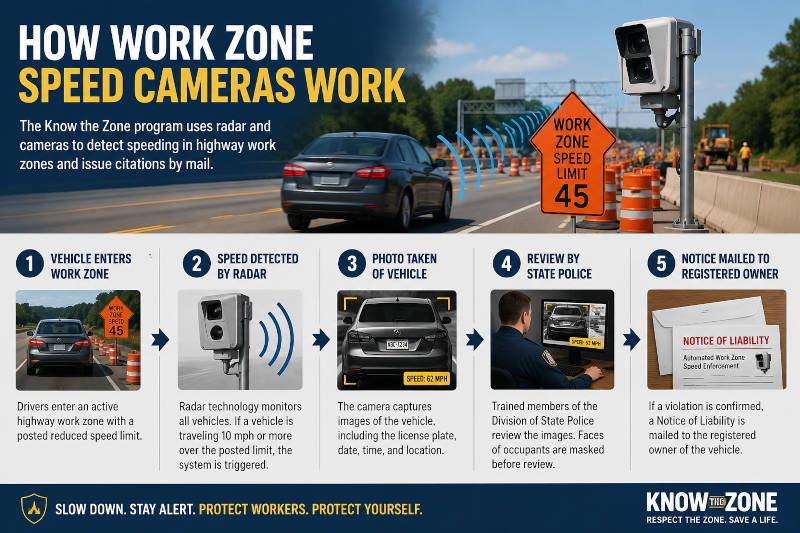
Connecticut’s Work Zone: Automated Work Zone Speed Control Program is a radar-based enforcement system deployed at active highway construction sites. Cameras detect any vehicle traveling 10 mph or more above the posted work zone speed limit and photograph the vehicle for review.
The numbers from the program’s testing phase — conducted between March and May 2026 — reveal just how widespread this behavior is on Connecticut roads. Out of more than 8.4 million vehicle scans recorded across active work zones, approximately 1.36 million came back over the limit. That’s roughly one in six vehicles. More than 4,000 were clocked above 85 mph. More than 150 exceeded 100 mph.
Those aren’t highway anomalies. That’s everyday driving behavior that Connecticut is now prepared to penalize financially and at scale.
Where Are the Cameras Right Now?
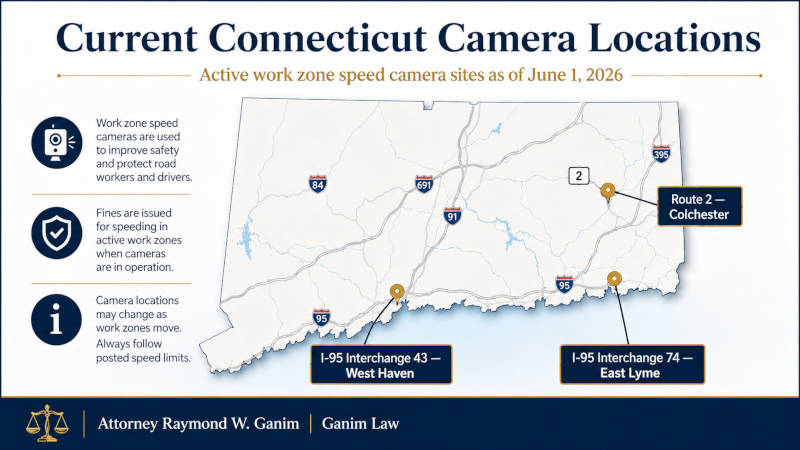
As of June 1, 2026, active enforcement cameras are operating at three locations:
– I-95 Interchange 43 — West Haven
– I-95 Interchange 74 — East Lyme
– Route 2 — Colchester
Additional sites are expected to come online as construction projects expand across the state. CTDOT has not published a fixed list of all planned future deployments, which means drivers cannot simply memorize a handful of known locations and adjust only there. The system is designed to move with active work zones.
What Are the Work Zone Speed Camera Penalties?
Understanding the fine structure matters — especially the timeline.
June 1 – July 5, 2026: Warning Period
The cameras are active and recording, but the system issues written warnings only. No fines. This window exists to notify drivers that enforcement is in place and to allow behavior to adjust before financial penalties begin.
July 6, 2026: Fines Begin
– First offense: Written warning
– Second offense within one calendar year: $75 fine
– Any vehicle detected at 85 mph or above: $75 fine on the first offense — no grace period
The legislation authorizing this program specifies that violations do not carry insurance points and do not appear on a driver’s official moving-violation record. That detail has led many people to assume the citations are low-stakes. That assumption deserves a closer look.
Why “No Insurance Points” Doesn’t Mean No Risk
The no-points provision was written into the program deliberately — Connecticut lawmakers wanted to focus the penalty on behavior change rather than license consequences. But the absence of points does not eliminate risk in every situation.
Here’s what that exemption does not cover:
Civil liability in an accident. If you were speeding in a work zone and a crash occurs, a camera citation from that same location and time frame can become evidence in a civil lawsuit. It doesn’t go on your driving record — but it can still surface in litigation.
Fleet and employer consequences. Commercial drivers and employees using company vehicles may face internal consequences regardless of what appears on a state driving record. Many fleet policies carry independent standards that don’t rely on the state’s points system.
The registered owner problem. Notices of liability go to the registered owner of the vehicle — not necessarily the person who was driving. If your employee, your teenager, or someone you lent your car to was behind the wheel, the citation still comes to you. Redirecting it requires affirmative, timely action.
Stacking violations. A second offense within one calendar year triggers the $75 fine. For frequent commuters on affected corridors, multiple warnings can stack into fines faster than expected.
How the Citation Process Works
All violations identified by the work zone speed cameras go through a review process before a Notice of Liability is mailed. The Division of State Police, within the Connecticut Department of Emergency Services and Public Protection, reviews the photographic evidence. Facial features of any vehicle occupants are masked in all images prior to that review.
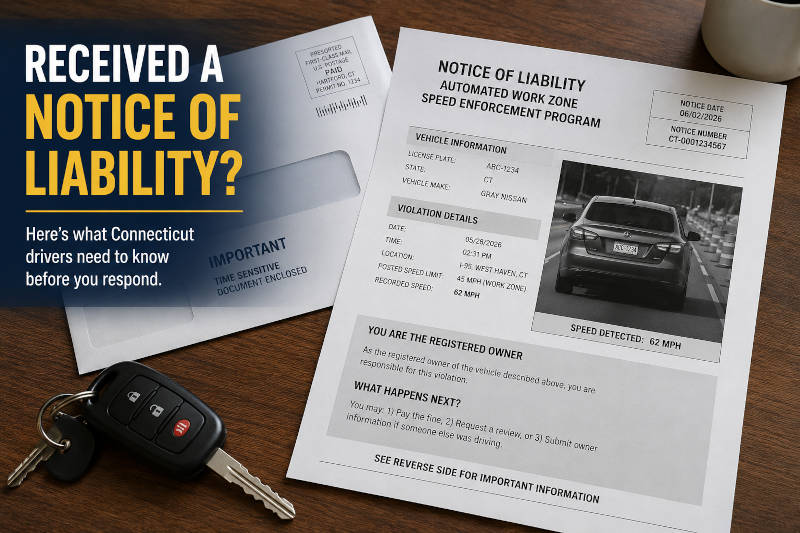
When the Notice reaches the registered owner, it includes the date, time, location, speed recorded, and photographic documentation of the vehicle.
From that point, the registered owner has options — but those options have deadlines and procedural requirements. Missing a response window or submitting an incomplete response can complicate your position in ways that are difficult to undo.
What to Do If You Receive a Work Zone Speed Camera Notice
If a Notice of Liability arrives in the mail, take these steps before doing anything else:
1. Don’t ignore it.
Ignoring a notice of liability is the most common and most damaging mistake drivers make. It is an administrative action that requires a response. Treating it like junk mail can result in additional penalties and forfeits your right to dispute the violation.
2. Review the date, time, and location carefully.
Confirm whether you — or someone authorized to use your vehicle — was at that location at that time. Errors in automated systems do occur, and photographic evidence can be reviewed and challenged.
3. Document your travel.
If you have records of your location around the time indicated — GPS data, toll records, phone location history, receipts — preserve them immediately. Digital records can disappear fast.
4. Determine whether you were actually driving.
If someone else was operating your vehicle, Connecticut law provides a mechanism to identify the actual driver as the responsible party. That process has specific procedural requirements and must be initiated correctly.
5. Consult an attorney before responding if you plan to dispute.
If you believe the citation was issued in error, if someone else was driving, or if you want to contest the circumstances, speak with an attorney before submitting any response. Once you respond a certain way, your options narrow.
How Ganim Law Can Help
Ganim Law represents Connecticut drivers — not in the abstract, but on the roads you actually use every day. I-95 through Fairfield County, the Merritt Parkway, the corridors connecting Bridgeport to New Haven, Milford to Shelton. We understand both the legal landscape and the real-world pressures Connecticut commuters deal with.
If you receive a Notice of Liability under the Know the Zone program, we can help you evaluate your options — including whether the citation can be disputed, whether your ownership of the vehicle creates a specific legal issue, and what your exposure looks like if an accident has already occurred near the cited zone.
Our firm has handled motor vehicle matters in Connecticut for more than 25 years. We know how automated enforcement programs interact with civil liability, insurance disputes, and administrative processes. A conversation with our team costs you nothing upfront.
The Bigger Picture
Connecticut joining the list of states using automated work zone speed enforcement is not a short-term experiment. Maryland, Pennsylvania, Illinois, New York, and Oregon have all implemented similar programs — and none have reversed course. Once this type of enforcement is in place, it tends to expand.
The warning period through July 5 is a real opportunity to adjust habits before fines begin. The camera locations are disclosed. The speed thresholds are defined. The fine structure is published. Connecticut has provided more advance notice than most states require.
What changes on July 6 is clear: the cameras stop issuing warnings and start issuing financial consequences. For the roughly 16 percent of Connecticut drivers recorded speeding through work zones during testing, behavior that went unpenalized this spring will carry a price tag this summer.
If you drive through an active work zone — along I-95 in West Haven or East Lyme, or Route 2 in Colchester — the approach is straightforward: slow to the posted limit when the signs say you’ve entered a work zone, and hold it until the signs say you’ve cleared it.
And if a notice arrives anyway, don’t handle it alone.
Attorney Raymond W. Ganim has represented Connecticut motorists for more than 25 years. Ganim Law is located at 2620 Nichols Avenue, Stratford, CT 06614. To speak with our team about a work zone speed cameras citation or any motor vehicle matter, call 203-377-7700 or visit ganimlaw.com.
This article is intended for general informational purposes and does not constitute legal advice. Reading this article does not create an attorney-client relationship. For advice specific to your situation, please contact a qualified Connecticut attorney.